Understanding the RAG Lifecycle: From Documents to Grounded AI Answers
How Retrieval-Augmented Generation helps AI systems deliver more relevant, evidence-based responses
Generative AI has transformed how we interact with information. However, large language models (LLMs) can sometimes provide outdated information, miss important details, or generate answers that are not supported by reliable evidence.
This is where Retrieval-Augmented Generation (RAG) becomes valuable.
RAG connects a language model to an external knowledge source, allowing it to retrieve relevant information before generating an answer. Rather than relying entirely on its training data, the model can use documents, company policies, product information, technical guides, and other trusted sources to respond to questions.
But how does RAG work in practice?
Let's explore the complete RAG lifecycle, from preparing knowledge sources to monitoring and improving the system.
1. Prepare the knowledge sources
Every RAG application begins with information.
Knowledge sources might include PDF documents, Word files, text files, websites, product catalogues, internal company policies, or technical documentation.
Before this information can be used effectively, it needs to be collected, reviewed, and prepared.
Typical activities include:
-
Identifying relevant knowledge sources.
-
Extracting and cleaning document content.
-
Removing unnecessary formatting and duplicate information.
-
Standardising document structures.
-
Applying appropriate security and access controls.
Why does this matter?
The quality of a RAG system depends heavily on the quality of its source information. Inaccurate, outdated, or poorly structured documents can lead to irrelevant retrieval and unreliable answers.
2. Ingest and index the documents
Once the documents are prepared, the next step is to make their content searchable.
Long documents are often divided into smaller sections called chunks. Chunking helps the system retrieve the specific information needed to answer a question instead of supplying an entire document.
The system can then generate embeddings for these chunks.
An embedding is a numerical representation of text that captures aspects of its meaning. Text with similar meanings can have similar vector representations.
These embeddings, together with the original text and relevant metadata, are stored in a search index.
For example, Azure AI Search can store document content, titles, categories, and vector fields to support different retrieval methods.
Key activities:
-
Split documents into manageable chunks where appropriate.
-
Generate embeddings using an embedding model.
-
Store text, vectors, and metadata.
-
Configure the search index for keyword and vector retrieval.
The result is a searchable knowledge base that supports the next stage of the RAG lifecycle.
3. Retrieve relevant information
When a user asks a question, the system must identify the information most likely to help answer it.
There are several retrieval approaches.
Keyword search identifies relevant content using words and phrases in the query.
Vector search compares embeddings to find semantically similar content, even when the query and source document use different wording.
Hybrid search combines keyword and vector search, bringing together lexical matching and semantic similarity. Azure AI Search can combine these rankings using Reciprocal Rank Fusion (RRF).
Consider this question:
“What if the product arrives damaged?”
A company document might say:
“Return shipping costs are paid by the customer unless the item is faulty or incorrect.”
A keyword-only search may be less effective if the exact words in the question do not appear in the document. Vector search can help identify the related concept, while hybrid search combines semantic similarity with keyword evidence.
The search system returns the most relevant documents or chunks for the next stage.
4. Augment the prompt with retrieved evidence
Retrieval alone does not generate an answer. The retrieved information must be supplied to the language model alongside the user's question.
This is the augmentation stage.
The application constructs a prompt containing:
-
The user's original question.
-
Relevant retrieved content.
-
Instructions about how the model should answer.
-
Requirements for handling missing information and citing sources where appropriate.
For example, the application might instruct the model to answer using only the supplied evidence and to state clearly when the context does not contain enough information.
This helps keep the response focused on the available knowledge.
However, prompt instructions do not guarantee that every answer will be correct. Retrieval quality, source accuracy, model behaviour, and evaluation all remain important.
5. Generate a grounded response
The augmented prompt is passed to a large language model.
The model uses the question and retrieved evidence to generate a natural-language answer.
For example, a customer might ask whether they can return a faulty product. Instead of displaying a complete policy document, the application can produce a concise explanation based on the relevant return policy.
The model can also be instructed to acknowledge uncertainty when the retrieved content does not provide a sufficient answer.
This is an important distinction: RAG does not retrain the model whenever a new document is added. It retrieves external information at query time and supplies that information as context.
6. Deliver the answer to the user
The generated response is returned through a chatbot, website, internal application, customer-support tool, or another interface.
A well-designed RAG application may also include:
-
Links or references to the source documents.
-
Clear explanations of relevant policies.
-
Follow-up questions.
-
Appropriate handling of unanswered questions.
-
Access controls to prevent users from receiving information they are not authorised to see.
The goal is not simply to generate fluent text. It is to provide a useful answer that is relevant to the question and supported by appropriate evidence.
7. Monitor, evaluate, and improve
The RAG lifecycle does not end when the answer is delivered.
Real-world knowledge bases change. Documents become outdated, new policies are introduced, and users ask questions that expose gaps in the system.
Continuous evaluation helps identify these problems.
Important areas to monitor include:
-
Retrieval relevance: Are the right documents being retrieved?
-
Answer quality: Does the response accurately reflect the evidence?
-
Grounding: Are claims supported by the retrieved content?
-
Coverage: Can the system recognise when information is missing?
-
Performance: How quickly does the system respond?
-
Cost: How much do embedding, search, and model requests cost?
-
Security: Are documents and responses restricted to authorised users?
Improvements may involve refining chunks, adjusting search parameters, adding metadata filters, updating documents, improving prompts, or introducing better evaluation methods.
RAG is therefore an iterative process rather than a one-time implementation.
Putting the complete lifecycle together
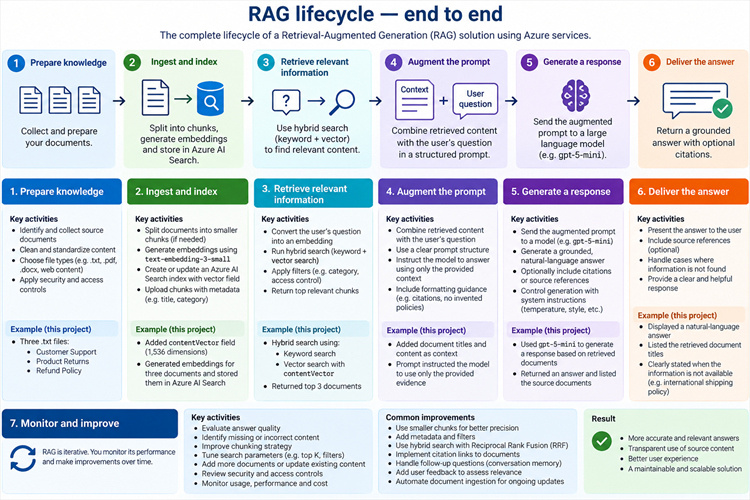
The end-to-end RAG lifecycle can be summarised in six operational stages:
-
Prepare: Collect and clean the knowledge sources.
-
Index: Chunk the content, generate embeddings, and store searchable information.
-
Retrieve: Find relevant evidence using keyword, vector, or hybrid search.
-
Augment: Combine the retrieved evidence with the user's question.
-
Generate: Use a language model to produce a grounded response.
-
Deliver: Return the answer and, where appropriate, its sources.
A seventh continuous activity—monitoring and improvement—helps keep the solution useful as information, user needs, and system requirements evolve.
A practical example using Azure AI
To understand these concepts beyond theory, I built a small RAG application using Azure AI Foundry and Azure AI Search.
The example uses three fictional documents covering refunds, product returns, and customer support.
The application generates embeddings with text-embedding-3-small, stores them in an Azure AI Search vector field, and uses hybrid search to retrieve relevant information. It then passes the retrieved content and user's question to gpt-5-mini to generate a natural-language answer.
This practical exercise demonstrated how the different components work together:
-
Azure AI Search provides the retrieval layer.
-
Embeddings support semantic search.
-
Hybrid search combines keyword and vector retrieval.
-
The language model generates an answer using retrieved context.
-
Source document titles help identify which knowledge was retrieved.
The prototype also illustrates an important limitation: if the documents do not contain the answer, the application must be designed to communicate that limitation instead of inventing a policy.
For a more advanced implementation, the next steps would include chunking larger documents, improving retrieval evaluation, adding source citations, and monitoring answer quality.
Final thoughts
RAG is an important architectural approach for building AI applications that need to work with external or organisation-specific knowledge.
Its effectiveness depends on more than the language model alone. Document preparation, indexing, retrieval quality, prompt design, security, and continuous evaluation all contribute to the result.
Understanding the complete lifecycle makes it easier to design AI applications that are more relevant, maintainable, and transparent about the information behind their answers.
The key takeaway: A successful RAG application does not simply generate an answer. It retrieves relevant evidence, uses that evidence to guide generation, and continuously improves how information is found and presented.
Have you implemented a RAG application or experimented with Azure AI Search? Which stage do you find most challenging: document preparation, retrieval, or answer generation?
Thanks, for reading the blog, I hope it helps you. Please share this link on your social media accounts so that others can read our valuable content. Share your queries with our expert team and get Free Expert Advice for Your Business today.