My AI-103 Journey: How I Prepared, Practised and Passed
How an inspiring event, hands-on experimentation, structured learning and practical labs helped me take the next step in my AI journey.
It Started with an Event
My AI learning journey didn't start in a day. It developed step by step, beginning with an experience that inspired me to explore Artificial Intelligence more deeply.
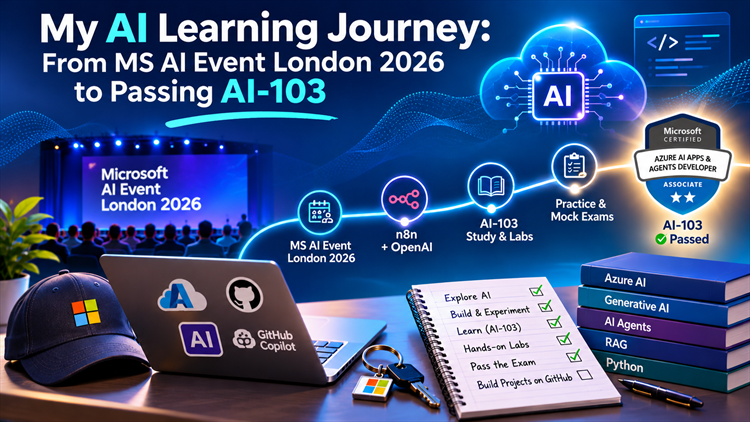
It started with MS AI Event London 2026.
Attending the event and taking part in live AI sessions with the Microsoft team was a fantastic learning experience. It gave me the opportunity to explore new ideas, discover useful resources and see how quickly AI is evolving.
More importantly, it motivated me to continue learning beyond the event itself.
During the event, I discovered resources such as Microsoft AI Skills Navigator and explored technologies such as GitHub Copilot. Discovering these tools helped me understand how many learning opportunities are available to people who want to develop their AI skills.
This is one reason I would encourage others to attend technology events whenever they have the opportunity. An event is not only about listening to presentations. It can help you discover new tools, meet people with similar interests, find learning resources and, sometimes, identify the direction you want to take next.
Even now, I have little reminders of that experience around me. I have stickers on my laptop, caps and key rings attached to my car keys. These might seem like small things, but whenever I see them, I remember the event and the motivation I gained from it.
For me, those items represent more than event memorabilia. They remind me of the decision I made to keep learning and exploring AI.
That inspiration became the starting point for what followed.
AI Beyond Technology: Making a Real-World Difference
At Microsoft's London AI events, including the Microsoft Frontier Tour London and Microsoft AI Tour, discussions highlighted how AI is being used across the UK to support healthcare.
One particularly important application is helping detect cancer earlier and accelerate diagnosis. AI can assist radiologists by analysing medical scans, identifying areas that may need further investigation and helping healthcare professionals prioritise cases. It can also help streamline administrative tasks and reduce time spent on routine processes, allowing more clinical time to be focused on patient care.
These applications reminded me that AI is about much more than models, code or automation. When developed and used responsibly, it has the potential to support professionals, improve workflows and make a meaningful difference to people's lives.
This strengthened my interest in exploring AI beyond theory and learning how to build practical solutions that address real-world challenges.
Exploring AI Through n8n and OpenAI
After the event, I continued experimenting with AI, particularly through n8n and OpenAI.
Rather than limiting myself to reading about AI, I wanted to understand how it could be used to solve practical problems. I started exploring AI-powered solutions and workflow automation, learning how AI models could be connected with different services and used as part of automated processes.
Working with n8n helped me think about how different components of a solution fit together. A workflow might receive information, process it, send it to an AI model, use the model's response and then perform another action.
This practical exploration raised more questions for me.
How do AI models generate responses? How can we guide their behaviour through system prompts? How can an application retrieve relevant information rather than rely only on what a model already knows? How can AI agents use tools to complete tasks? And how can we integrate these capabilities into useful applications?
I became increasingly interested in concepts such as:
-
Generative AI and large language models.
-
System prompts and instructions.
-
Retrieval-Augmented Generation (RAG).
-
AI agents and tool integration.
-
Image models and visual data.
-
Workflow automation and connecting AI services.
At this stage, my learning was largely driven by experimentation. I was discovering what was possible by trying things, exploring different approaches and learning from the results.
That experience gave me a useful practical foundation. When I later started studying Microsoft's Azure AI technologies, I could relate some of the concepts to things I had already explored.
I realised that I wanted to go further—not only experimenting with AI tools, but also developing a more structured understanding of how to build AI applications.
Why I Chose AI-103
Once I decided to study AI more systematically, I began researching Microsoft's AI certification options and the learning resources available.
I wanted a learning path that would help me develop practical knowledge of AI applications, agents and related Azure services.
At the time, based on the certification information I was reviewing, I understood that AI-102 was approaching retirement. I therefore decided to focus on AI-103 as my next learning goal, while keeping further AI certifications as a longer-term ambition.
My objective was not simply to pass an examination. I wanted to understand the technologies, practise the concepts and build a foundation that I could use in real projects.
I enrolled in the Udemy course AI-103 Azure AI Apps & Agents Developer Associate Exam Prep and combined it with Microsoft's official learning resources, practical labs and mock exams.
This combination gave my learning a clearer structure.
Learning Through Udemy and Microsoft Learn
I used the Udemy course as one part of my preparation. It helped me organise my study and work through the topics in a more structured way.
However, I did not want to depend on a single course. I also used the official Microsoft Learn certification preparation resources.
The learning paths listed on the page covered several important areas of Azure AI development:
| Microsoft Learn learning path | Duration shown |
|---|---|
| Develop generative AI apps in Azure | 6 hr 52 min |
| Develop AI agents on Azure | 10 hr 42 min |
| Develop natural language solutions in Azure | 5 hr 46 min |
| Extract insights from visual data on Azure | 7 hr 6 min |
| Total listed learning time | 30 hr 26 min |
These learning paths helped me explore different parts of the Azure AI ecosystem, from generative AI applications and agents to natural language processing and visual data.
I found it useful to combine the structured explanations from the course with Microsoft's own documentation. When a concept was unclear, I could revisit the relevant learning material and connect it with the practical work I was doing.
My approach was to learn a concept, explore how it worked, practise it where possible and then revise it.
Hands-On Practice: Learning by Building
One of the most valuable parts of my preparation was working through practical labs.
For me, hands-on learning was important because reading about a technology and implementing it are two different experiences. A concept may sound straightforward in a lesson, but using it in practice introduces questions that you cannot always answer by memorising notes.
My practical work covered several areas, including:
-
Azure AI Foundry: Exploring the environment used to develop and work with AI applications and models.
-
Generative AI applications: Learning how models can be configured and used within applications.
-
Python-based AI development: Working with Python to interact with AI services and build practical solutions.
-
Retrieval-Augmented Generation (RAG): Exploring how applications can retrieve relevant information to support model responses.
-
AI agents: Learning about agent-based approaches and how AI systems can work with tools.
-
Authentication and identity: Working through the practical considerations of accessing Azure AI services securely.
-
Computer vision: Exploring how AI can analyse and interpret visual information.
-
PDF extraction and document processing: Working with document content and extracting useful information from files.
-
Monitoring and evaluation: Exploring how to observe application behaviour, inspect responses and capture operational information.
I also worked through the practical challenges that come with development, including model configuration and authentication.
Sometimes, understanding why something does not work is just as valuable as getting it to work. Troubleshooting helps you understand the relationship between the code, configuration, identity and service you are using.
My previous experimentation with n8n and OpenAI helped me relate these new concepts to practical AI workflows. I could connect what I was learning in Azure with the broader goal of building applications that use AI to perform useful tasks.
The biggest lesson from the labs was that practical experience helps turn theoretical knowledge into something you can apply.
I did not want my preparation to end with an exam result. I wanted to develop skills that I could continue using after the examination.
Mock Exams: A Useful Way to Identify Gaps
Alongside the courses and labs, I used mock exams to assess my understanding.
I practised using Microsoft AI Skills Navigator, where my scores generally ranged from 76% to 88%.
These results gave me an indication of the areas I understood and the topics I needed to revisit. However, I also noticed that some questions appeared repeatedly.
That taught me an important lesson: a high mock-exam score does not necessarily mean you are ready for the real examination.
When questions repeat, it can become easy to recognise the answer without fully understanding the underlying concept. I tried to treat the practice results as a guide rather than a guarantee.
Instead of focusing only on the score, I paid attention to the reasoning behind an answer. I asked myself why a particular approach was appropriate, what the alternatives meant and how I would approach a similar problem presented in a different scenario.
I also used AI-assisted practice questions to revise scenario-based concepts. These were useful as an additional learning aid, particularly when I wanted to test my understanding of a topic from a different angle.
However, I treated AI-generated questions as supplementary practice, not as official exam questions or a replacement for Microsoft's learning materials.
My advice is simple: use mock exams to find your knowledge gaps, not just to collect high scores.
What I Learned About Preparing for AI Certifications
Looking back, several lessons stand out.
1. Start with curiosity, not just a certificate.
My journey began with an event that motivated me to explore AI. That initial curiosity helped me continue when the learning became more technical.
2. Combine different learning resources.
The Udemy course gave me structure, Microsoft Learn provided official learning material, and practical labs helped me apply what I was learning. Each played a different role.
3. Understand concepts rather than memorising answers.
AI technologies are easier to apply when you understand what a service does, why you would use it and how it differs from other approaches.
4. Practise the technical work.
Hands-on labs helped me connect theory with implementation. They also exposed me to configuration, authentication and troubleshooting—important parts of developing real applications.
5. Learn from mistakes and unfamiliar scenarios.
Repeated practice questions can be helpful, but unfamiliar questions encourage you to think. Understanding why an answer is correct is more valuable than simply remembering it.
6. Connect new knowledge with what you already know.
My earlier work with n8n and OpenAI helped me relate concepts in Azure AI to practical applications. Learning became more meaningful when I could connect new ideas with previous experience.
7. Keep learning after the examination.
A certification can mark progress, but it does not mark the end of the learning journey. Technologies change, new tools emerge and there is always more to explore.
Passing AI-103: A Milestone, Not the Finish Line
On 22 November 2026, I passed the AI-103 exam.
I was pleased to reach this milestone because it represented more than the examination itself. It brought together the inspiration I gained at MS AI Event London 2026, my experiments with n8n and OpenAI, the time spent studying and the practical work I completed.
Every stage contributed something different.
The event encouraged me to explore. Experimenting with AI helped me understand its practical possibilities. Structured study gave my learning direction. Labs helped me put concepts into practice, and mock exams helped me identify areas for revision.
Passing the exam was an important achievement, but I see it as one step in a much longer journey.
I want to keep developing my technical skills and gain more experience building useful AI-powered solutions.
My Next Step: Building AI Projects and Sharing Them on GitHub
Now I want to move from preparation towards building and sharing more practical projects.
My plan is to start developing AI projects and upload them to my GitHub account so that other people can explore the code, learn from the implementation and use the projects as inspiration for their own work.
I want to turn the concepts I have been learning into practical examples. These may include AI-powered applications, automation workflows, solutions using Azure AI services, and projects that bring together Python, generative AI and AI agents.
As I develop each project, I hope to document what I built, the technologies I used, the challenges I encountered and the lessons I learned.
I believe sharing practical work can be valuable for people who are also learning AI. A project does not need to be complicated to be useful. Sometimes, a clear example that explains one concept well can help someone else understand it much faster.
My aim is to keep learning by building and, at the same time, contribute something useful to the wider learning community.
I will share the projects on GitHub as they become ready. I hope they will help others who are exploring AI development, preparing for certifications or looking for practical examples to learn from.
Final Thoughts
When I look back at this journey, I realise that progress often begins with a small step: attending an event, discovering a resource, trying a new tool or deciding to learn something more deeply.
For me, that first step was MS AI Event London 2026.
What followed was a combination of curiosity, experimentation, structured learning, practical labs and examination preparation. Each stage helped me move forward.
Passing AI-103 is a milestone I am proud of, but I am even more interested in what comes next: building projects, developing my skills and sharing what I learn with others.
If you are starting your own AI learning journey, my encouragement is to stay curious, experiment, practise and keep going. You do not need to understand everything on day one. Start with what interests you, build on it and learn one step at a time.
And if you get the opportunity to attend an AI or technology event, take it. You never know which session, conversation or newly discovered resource might inspire your next step.
My journey continues—and my next chapter will be about building and sharing AI projects.
#AI103 #AzureAI #MicrosoftLearn #GenerativeAI #AIAgents #ArtificialIntelligence #Python #Automation #GitHub #ContinuousLearning
Thanks, for reading the blog, I hope it helps you. Please share this link on your social media accounts so that others can read our valuable content. Share your queries with our expert team and get Free Expert Advice for Your Business today.