How AI-Powered Content Approval Workflows Help Businesses Save Time Without Losing Human Control
From a Personal Challenge to an AI Solution
I enjoy sharing knowledge. Whether it's software development, .NET, AI, cloud technologies, or workflow automation, I regularly write blog articles to help developers and businesses learn from my experiences.
However, like many software engineers, I often found myself facing the same challenge.
Writing the blog wasn't the difficult part.
The difficult part was finding time to create a LinkedIn post, rewrite it several times, choose the right hashtags, review the content, and finally publish it.
There were many occasions when I published an article on my website but never shared it on LinkedIn or other social media platforms—not because I didn't want to, but because client work and project deadlines always took priority.
Eventually, I realised I was spending too much time on repetitive tasks instead of creating valuable content.
That's when an idea came to mind.
What if AI could prepare the first draft while I remained in complete control of the final decision?
I didn't want AI to replace me.
I wanted AI to become my assistant.
My goal was simple:
- Read my content.
- Understand what I wanted to say.
- Create a professional LinkedIn post.
- Suggest relevant hashtags.
- Allow me to review the content.
- Accept my feedback if changes were needed.
- Automatically publish the final approved version.
In other words, I wanted AI to handle the repetitive work while I focused on the message.
That idea eventually evolved into an AI-powered workflow that combines artificial intelligence with human approval to streamline the entire content publishing process.
Although I built this solution to solve my own problem, I quickly realised the same approach could help many businesses automate repetitive workflows while keeping people in control of important decisions.
What Is an AI Agent?
An AI Agent is more than a chatbot or a text generator.
It is an intelligent workflow that can understand information, make decisions based on predefined rules, interact with business systems, and involve humans whenever approval is required.
Rather than replacing people, AI Agents help automate repetitive tasks so teams can focus on strategic work.
A Typical Social Media Publishing Workflow
Imagine your marketing team sends an email announcing a new product feature.
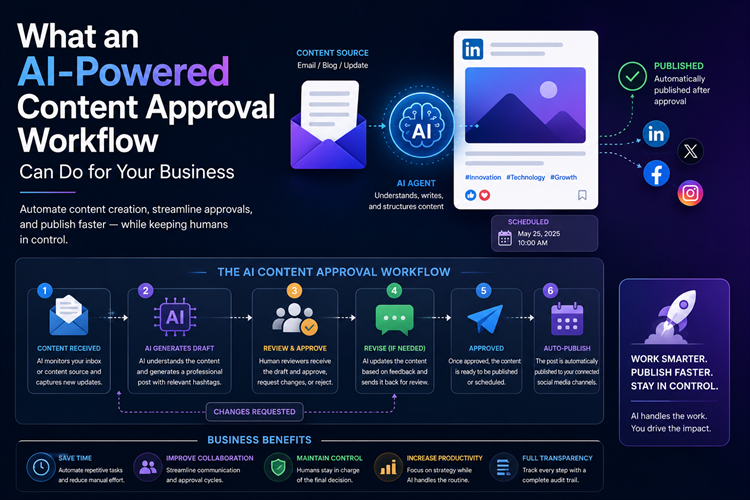
Instead of manually copying information between different tools, an AI-powered workflow could:
- Monitor a dedicated business mailbox.
- Understand the email content.
- Generate a professional LinkedIn post.
- Suggest relevant hashtags.
- Send the draft for approval.
- Accept revision requests.
- Produce updated versions based on feedback.
- Queue the approved content for publishing.
- Maintain a complete audit trail of every decision.
The result is a streamlined process that reduces manual work while keeping humans involved at key decision points.
Human-in-the-Loop AI
One of the biggest concerns organisations have about AI is losing control over published content.
A well-designed AI workflow addresses this by keeping people in charge of final decisions.
Instead of publishing automatically, the AI can present a draft for review.
Decision-makers can:
- Approve the content.
- Request revisions with specific feedback.
- Reject the post entirely.
This ensures that every published post aligns with the organisation's brand, tone, and business objectives.
AI becomes an intelligent assistant rather than an autonomous publisher.
Business Benefits
Implementing an AI-powered content workflow can provide several advantages:
Save Time
Routine tasks such as content drafting, formatting, and publishing can be completed in minutes instead of hours.
Improve Consistency
AI can follow predefined writing guidelines to maintain a consistent brand voice across all content.
Faster Approval Cycles
Rather than exchanging multiple emails, reviewers can approve or request changes through a structured workflow.
Better Collaboration
Marketing teams, business stakeholders, and management all work within the same approval process.
Full Traceability
Every version, approval, revision, and publication can be recorded, making it easier to track content history and support governance requirements.
Where Can This Approach Be Used?
Although social media publishing is a practical example, the same architecture can support many other business processes.
Examples include:
- Marketing campaign approvals
- Customer support response generation
- Sales proposal creation
- HR onboarding workflows
- Knowledge base article generation
- Internal communications
- Product launch announcements
- Compliance document reviews
- Report generation
- Email summarisation and routing
The underlying concept remains the same:
AI performs repetitive work while people make the final business decisions.
Why Human Oversight Still Matters
Generative AI is incredibly capable, but it isn't perfect.
Business content often requires:
- Brand consistency
- Regulatory compliance
- Accurate product information
- Appropriate tone
- Strategic messaging
Keeping humans involved at approval points ensures organisations benefit from AI without sacrificing quality or accountability.
Looking Ahead
As AI technologies continue to evolve, workflow automation will move beyond content generation.
Future AI Agents will increasingly be able to:
- Coordinate tasks across multiple business systems.
- Analyse business data to support decision-making.
- Personalise customer communications at scale.
- Recommend actions based on historical outcomes.
- Automate complex, multi-step business processes.
The opportunity extends far beyond marketing. AI Agents are becoming an important part of modern digital transformation strategies.
Final Thoughts
AI should not be viewed as a replacement for people. Its greatest value lies in helping professionals eliminate repetitive work, accelerate routine processes, and make better use of their time.
An AI-powered social media publishing workflow is just one example of how intelligent automation can improve efficiency while maintaining human oversight.
As more organisations explore AI adoption, the businesses that combine artificial intelligence with well-designed workflows and governance will be best positioned to scale their operations effectively.
Thanks, for reading the blog, I hope it helps you. Please share this link on your social media accounts so that others can read our valuable content. Share your queries with our expert team and get Free Expert Advice for Your Business today.